
What good is it being a manager if you can’t do what you really want?
We use our power best when it comes from a deep desire. When we do this, we create our world from the most alive and beautiful parts of ourselves.
Acting from a place of true longing not only gets us what we want but also benefits everyone around us. It creates a world that aligns with who we truly are right now.
So, it’s crucial to know what you want and learn how to express it to influence others.
Almost every manager I work with, I ask “What do you want out of this project or program? What do you really want?”. These days, the answer often is something like: “My team is already struggling to get all the work done, and now the director wants us to increase our production significantly. I don’t know how to achieve that. Can you help me be more productive? Can you help my team focus on getting the work done?”
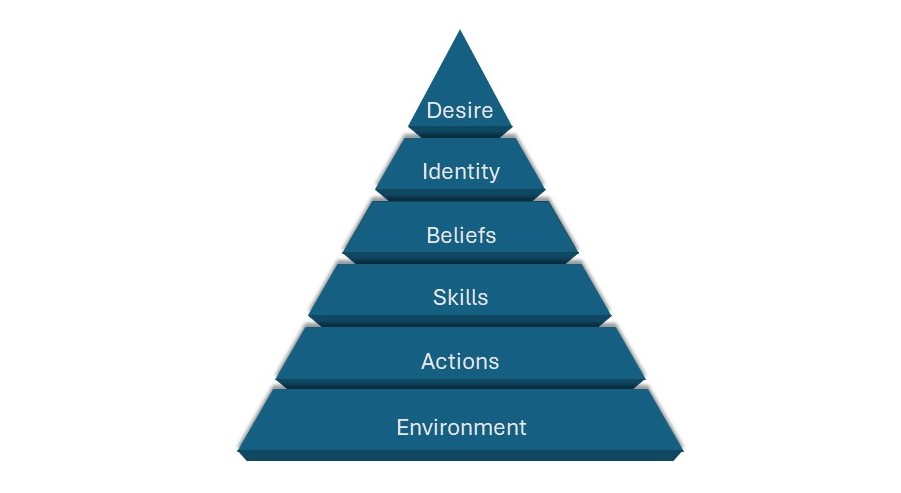
Many managers focus on changing behavior and skills, which can be very effective. Anyone looking to boost their team’s productivity has probably used goals, KPIs, or process improvements to become more efficient. But often, these approaches don’t bring the desired result. The logical levels model by Bateson can help understand why.
This model says our experience can be understood at different levels. Starting from the bottom:
Environment: What are your circumstances? You may have more work than you can handle, targets to achieve, undercapacity, customer problems, a team that needs you to manage conflict, team members who bring their problems to you, departments doing projects that affect your team, a director that announces new changes.
Actions: What are you doing to produce the results you’re getting? You might work harder and harder, prioritize urgent issues, and spend a lot of time firefighting. You’re always “on” and maybe secretly resent the team for not getting the work done.
Skills: What skills do you use? You might focus on efficiency, setting goals, and holding the team accountable for hitting numbers. You learn to prioritize quantity over quality until things improve. You might do training or hire a coach, to tell you what to do.
You’re doing all the things, and yet, the situation isn’t changing much.
That’s because your BEING determines how good your DOING is.
From here on up in the model are the pieces that determine who you are being.
Achieving your goals and having a great time doing it requires skills that most managers haven’t trained. You can’t afford not to learn these. Put in the time and effort.
If you want to win, you have to get in the game.
Beliefs: The next level is beliefs; perspectives and ideas we hold true. We don’t question these; “it is what it is.”
What beliefs are holding you back?
You might believe the most important thing is staying in business, which is secured by hitting targets. In stressful times, everything else is a “nice-to-have” – team building, skill development and quality improvement have to wait until the workload is manageable again.
Identity: What identities do you have? You might be a manager, a husband, a mother, an artist.
Which identities are feeding your actions? You might take on the identity of “I am not enough”, “I am not important”, or “I am powerful”.
You know you’re a powerful, competent manager, but you may feel that the expectations don’t align with your strengths. This brings doubt, making you hesitant to speak up, or do what you think is best.
Vision: What do you truly want? What is your deepest desire? What do you want to bring to this world?
You might hope to make a difference, contribute to customers’ lives, guide the team to excellence, and bring prosperity to the organization. But that feels out of reach under the current circumstances…
I see this all too often.
I help managers who want to change this. Managers who are committed to achieving their ambitious goals and having a great time doing it.
The way to get what you want is to become the person, take on the identity, that naturally creates the results that you want.
So you start with the vision, your desire.
Then, you must decide who you need to become to make this vision a reality.
You act from this identity.
If you start making plans, decisions and taking actions that thriving managers make, you will create thriving.
If you keep making plans, decisions and taking actions that struggling managers make, you’ll keep struggling.
As long as you keep doing the low-value work and solving the comfortable problems, you’ll never do the things you really need to be doing.
Working harder and harder is avoiding the tough decisions, and you’ll keep getting mediocre results and an uninspiring environment in return.
We all have 24 hours in a day. You need to spend your time on high-value activities that bring the results you desire.
Examples:
Desire: Guide the team to optimal performance, contribute to customers’ lives, bring prosperity to the organization, and have a great time doing it.
Identity: I get the best out of others and myself, I know what I want, I stay true to myself and my values, I stand strong, I dare to be seen as a leader.
Beliefs: It’s possible! What I want isn’t far away, Taking time to listen to what I want makes me more effective, I don’t need to doubt my truth when the other doesn’t see it.
Skills: Seeing how they’re getting in their own way, using emotions to know what’s true for them, navigating conflict and finding win-win solutions.
Actions: Stand up for what they want, Stop self-sacrificing, Have the conversations that need to be had, Not take things so personally, Experiment and play.
Environment: Clear focus and priorities, The team is inspired by your shared vision and consistently achieves the goals, People notice your relaxed confidence.
If you want to improve the results you’re getting and have a great time doing it, I invite you to take the time to fill out this pyramid for yourself, twice. Once describing your current situation starting from the bottom and once starting with what you desire to create, from the top down.
I’d love to hear what you learn; send me a message!